Weak documentation is an invisible drain on outsourced software projects. Uncover how it affects velocity, alignment, and operational stability.


.svg)
.svg)
In outsourced software projects, poor documentation rarely shows up as a direct line item, yet it quietly affects everything from delivery speed to long-term scalability. When teams underestimate these hidden costs and software documentation importance, they often focus only on hourly rates or delivery timelines, missing the deeper operational impact. Weak documentation increases dependency on specific individuals, slows onboarding, creates avoidable rework, and turns small clarifications into repeated meetings. Over time, this erodes trust between clients and offshore teams, reduces engineering velocity, and inflates total project cost without clear visibility. Knowing where these hidden costs come from helps decision-makers protect both budget and momentum, ensuring outsourced teams remain efficient, accountable, and aligned with business goals rather than becoming a long-term operational risk.
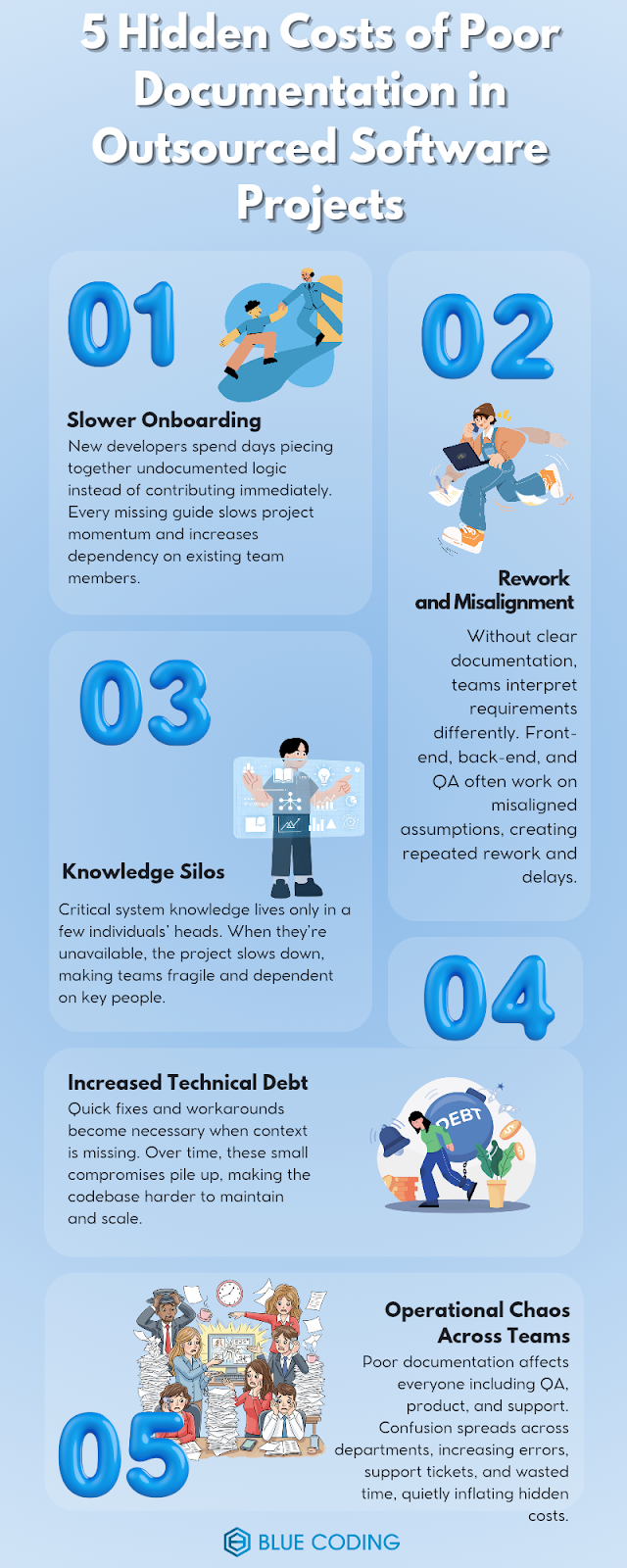
In outsourced projects, alignment depends heavilySly on written clarity. When documentation is vague, outdated, or scattered across tools, different teams interpret the same requirements in different ways. Front-end developers may build features based on assumptions that back-end teams were never aligned on, while QA tests against expectations that were never finalized. This lack of shared understanding leads to rework, delays, and repeated handoffs, creating a cycle where teams are technically productive but strategically misaligned. Let's look at some more ways in how outsourcing documentation challenges can cause issues for a business!
Poor documentation creates an environment where even simple development tasks feel unpredictable. Outsourced teams are forced to pause progress to clarify basic requirements, trace undocumented logic, or confirm assumptions that should have been clearly written down from the start. Instead of following a defined path, developers work reactively, jumping between tickets, meetings, and messages just to keep moving. This constant firefighting drains focus and momentum, turning structured project plans into loosely guided efforts driven by urgency rather than strategy.
One of the most damaging effects of poor documentation is the creation of knowledge silos. When critical system behavior lives only in someone’s memory rather than in documentation, that individual becomes a bottleneck. Outsourced teams then rely heavily on a few “go-to” people for answers, approvals, or fixes. If those individuals are unavailable, productivity slows or stops entirely. Over time, this dependency turns routine development into a fragile operation where progress depends more on availability than on process and this is why understanding software documentation importance is critical!
Poor documentation makes onboarding new outsourced developers unnecessarily complex. Instead of ramping up through clear guides, architecture diagrams, and coding standards, new team members must piece together information from codebases, chat history, and informal explanations. This slows productivity, increases the risk of mistakes, and places extra pressure on existing team members who must constantly explain undocumented decisions. What should be a smooth scaling process becomes a recurring disruption every time the team grows or changes.
When developers don’t fully understand system logic or historical decisions, they often implement short-term fixes that solve immediate problems but introduce long-term complexity. These workarounds accumulate over time, creating technical debt that becomes harder and more expensive to manage. Poor documentation accelerates this process because teams lack the context needed to make informed decisions. As a result, the codebase becomes harder to maintain, harder to scale, and increasingly fragile with every release.
In well-documented projects, debugging follows a clear path. In poorly documented outsourced projects, it becomes a guessing game and is one of the worst poor documentation risks. Engineers spend excessive time tracing code, testing assumptions, and ruling out possibilities simply because system behavior was never clearly explained. Issues that should take hours to resolve can stretch into days or weeks. This not only increases delivery timelines but also inflates costs in ways that are difficult to track or justify on paper.
The chaos caused by poor documentation doesn’t stop at development. QA teams struggle to validate features without clear acceptance criteria. Product managers find it difficult to explain system behavior or plan future enhancements. Support teams face an increase in tickets because functionality isn’t well understood internally. Each department compensates for documentation gaps in its own way, creating inefficiencies across the entire organization. What appears to be a development issue quickly becomes a company-wide operational problem.
Clients often experience the effects of poor documentation indirectly through missed deadlines, inconsistent behavior, or repeated clarifications. When outsourced teams need constant confirmation or deliver features that don’t fully match expectations, confidence starts to erode. Even if the technical work is sound, the lack of transparency and predictability makes projects feel unstable. Over time, this damages trust and turns what should be a long-term partnership into a transactional, risk-driven engagement.
Working in a poorly documented environment is mentally exhausting. Developers are expected to deliver results without the clarity needed to do their best work. Over time, this frustration leads to disengagement and higher turnover. When developers leave, undocumented knowledge leaves with them, deepening the chaos for the remaining team. This cycle repeats, making each transition more disruptive and costly than the last, especially in outsourced setups where continuity is critical.
Outsourcing is meant to increase efficiency, scalability, and speed. Poor documentation does the opposite. It slows delivery, increases hidden costs, and introduces operational risk that grows over time. Instead of acting as an extension of the internal team, outsourced developers are forced to work with incomplete context and constant uncertainty. The result is a project that consumes more time, attention, and budget than expected, quietly transforming outsourcing from a strategic advantage into an ongoing source of chaos.
→ Establish documentation ownership from day one, not as an afterthought. Make it clear who is responsible for creating, updating, and validating documentation across requirements, architecture, workflows, and releases. When ownership is vague, documentation becomes optional, outdated, or fragmented, which is where chaos begins.
→ Treat documentation as a living asset, not a one-time deliverable. Ensure every meaningful code change, feature update, or architectural decision triggers a documentation review. This prevents teams from relying on outdated context and keeps outsourced developers aligned with how the system actually works, not how it worked months ago.
→ Standardize documentation formats across all outsourced teams. Use consistent templates for technical specs, onboarding guides, APIs, and handover documents. Standardization reduces interpretation gaps and allows new team members to quickly understand structure and expectations without constant clarification.
→ Centralize all documentation in a single, easily accessible source of truth. Avoid spreading critical information across emails, chat threads, or personal notes. When outsourced teams know exactly where to look for accurate information, decision-making becomes faster and far less error-prone.
→ Make documentation part of your delivery workflow, not a parallel task. Tie documentation updates to sprint completion, code reviews, and release checkpoints. This reinforces accountability and ensures documentation evolves alongside the product instead of lagging behind it.
→ Invest early in clear onboarding documentation for outsourced developers. Provide system overviews, business logic explanations, and development standards upfront. Strong onboarding reduces dependency on individuals and allows teams to contribute meaningfully without weeks of back-and-forth questions.
→ Encourage written clarification over verbal dependency. While meetings are useful, relying on verbal explanations creates knowledge gaps, especially in distributed teams. Ensure key decisions, assumptions, and changes are always captured in writing so knowledge doesn’t disappear when people rotate off the project.
→ Align documentation depth with project complexity, not timelines. Rushed projects often skip documentation to save time, only to lose far more time later through rework and confusion. Proper documentation upfront protects velocity instead of slowing it down.
→ Review documentation regularly from a usability perspective. Documentation should be readable, searchable, and relevant, not overly technical or abstract. If outsourced developers struggle to apply what’s written, the documentation isn’t serving its purpose.
→ Set documentation expectations clearly in outsourcing agreements. Define documentation standards, update frequency, and handover requirements contractually. This ensures documentation is treated as a core deliverable, not an optional courtesy.
→ Encourage a documentation-first mindset across teams. When developers understand that documentation protects their work, reduces interruptions, and prevents repeated explanations, it becomes part of the culture rather than a forced requirement.
→ Audit documentation health during project reviews, not just code quality. Look for gaps, inconsistencies, and outdated references. Regular audits help catch early signs of documentation debt before it turns into operational chaos.
→ Plan documentation handovers during team transitions or scaling phases. Whenever developers leave or teams expand, ensure knowledge transfer is written, reviewed, and validated. This prevents sudden slowdowns and protects continuity.
The Blue Coding team has firsthand seen how poor documentation quietly undermines outsourced software projects, even when the talent and intent are strong. This is one of the primary reasons why clients approach us as well! That’s why we treat documentation as a core part of delivery, not an afterthought. From discovery to long-term maintenance, we prioritize clear requirements, shared technical context, and continuously updated documentation that keeps distributed teams aligned and accountable. Our nearshore engineers work as true extensions of our clients’ teams, supported by structured processes that reduce dependency risks, speed up onboarding, and protect long-term scalability. Contact us today to discuss strategies that are right for YOUR business!


Subscribe to our blog and get the latest articles, insights, and industry updates delivered straight to your inbox