Senior developers are the backbone of successful outsourced teams. Learn what makes them essential beyond years of experience.


.svg)
.svg)
Outsourcing software development looks simple on paper. You hire a team, define the scope, and expect results. In reality, the outcome often depends on one critical factor that is easy to overlook: who is actually leading the work. The difference between a smooth, high-impact outsourced project and a frustrating one is rarely the location or the time zone. It is the level of experience behind the code. Senior developers bring more than technical skills. They bring clarity when requirements are vague, stability when systems grow complex, and confidence when decisions need to be made quickly. In outsourced teams, where context is limited and communication gaps are real, that experience becomes even more valuable. This article breaks down why senior developers matter more in outsourced teams than in-house ones, how to recognize true seniority, and when your project genuinely needs senior expertise versus junior support.
There is no strict rule, but most senior developers usually have 5 to 8+ years of real-world experience. Still, years alone do not make someone senior. What matters more is the depth of experience and the level of responsibility they have handled. A senior developer has worked on different types of projects, faced failures, fixed production issues, and understands how software impacts the business, not just the codebase.
A senior developer thinks before writing code. They ask why a feature is needed, how it will be used, and how it may affect the system in the future. They are comfortable making decisions, spotting risks early, and solving problems without constant guidance. When things go wrong, they stay calm and focus on solutions. What truly sets them apart is ownership and communication. Senior developers care about quality, scalability, and long-term stability. They guide junior developers, give clear feedback, and explain technical ideas in simple language. In short, a senior developer is someone who combines experience, judgment, and leadership to deliver reliable results, even in complex or uncertain situations.
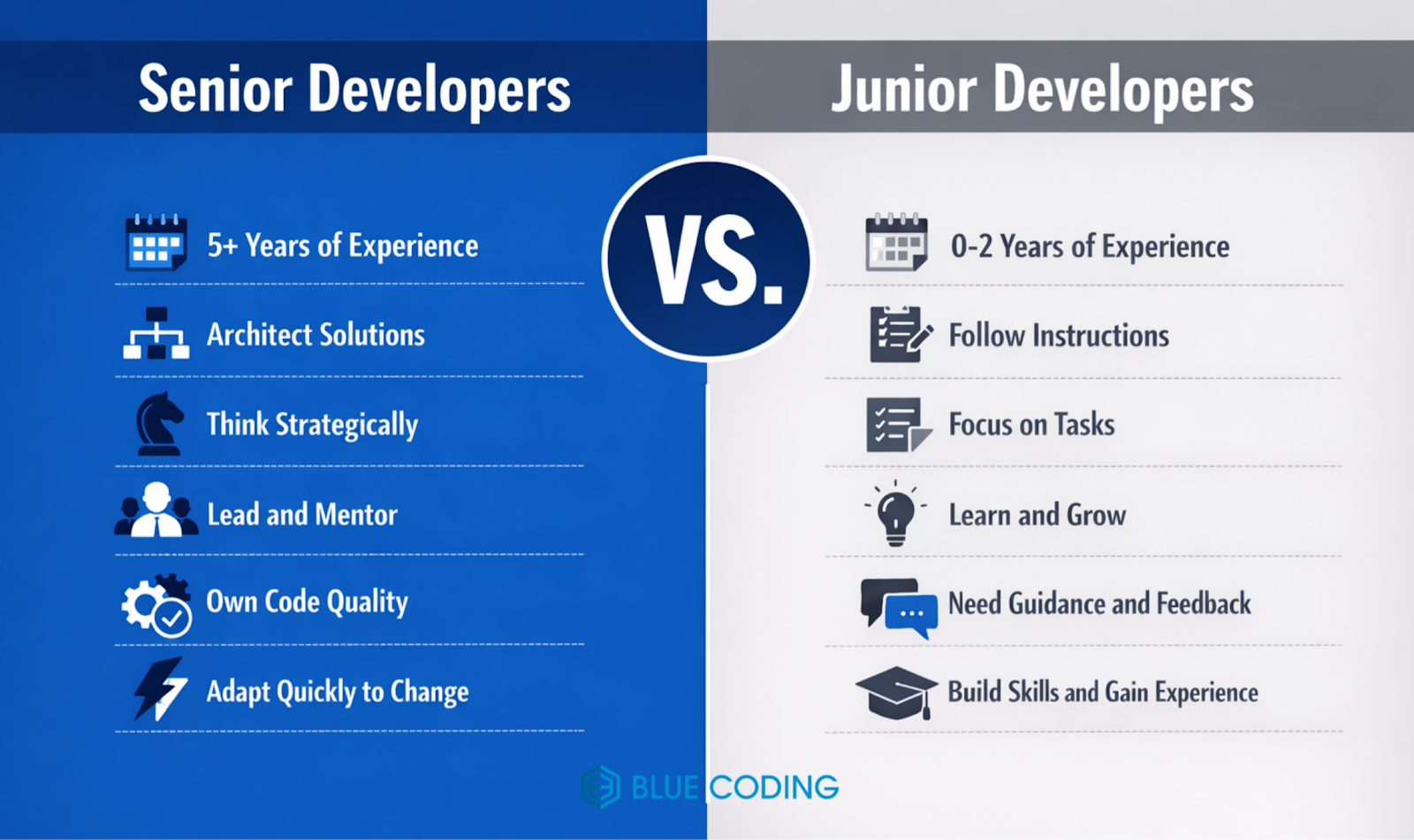
For many companies, outsourcing is a strategic move to scale faster, enter new markets, or accelerate product delivery. However, outsourced teams operate under very different conditions than in-house teams. They work across time zones, cultures, and organizational boundaries. In this environment, senior developers play a far more critical role. Their experience, judgment, and leadership often determine whether an outsourced engagement becomes a long-term success or a costly setback.
In an in-house setup, developers naturally absorb company culture, product vision, and internal processes through daily interactions. In outsourced teams, this context is not automatically available. Senior developers bridge this gap. They quickly understand the business logic behind features, not just the technical requirements. This allows them to align development decisions with your long-term goals rather than focusing only on task completion. Their ability to think like internal stakeholders helps outsourced teams feel less like external vendors and more like a genuine extension of your core engineering team.
Outsourced projects often rely heavily on documentation, tickets, and asynchronous communication. Junior or mid-level developers may follow instructions too literally, missing implied requirements or edge cases. Senior developers, on the other hand, read between the lines. They ask the right clarifying questions early and challenge unclear assumptions. This proactive mindset prevents rework, delays, and budget overruns. In outsourced environments, where feedback loops can be slower, this ability to interpret intent correctly is especially valuable.
In-house teams usually evolve systems gradually, with ongoing architectural discussions and refactoring. Outsourced teams are often expected to deliver quickly and integrate into existing systems with minimal disruption. Senior developers are better equipped to evaluate current architectures, identify constraints, and design solutions that fit cleanly within them. They understand trade-offs between speed, scalability, and maintainability. This ensures that outsourced contributions strengthen your system instead of adding technical debt that your in-house team must later clean up.
In-house teams benefit from organic leadership through proximity. Mentoring, code reviews, and problem-solving happen naturally. In outsourced teams, leadership must be intentional. Senior developers provide this structure. They set coding standards, enforce best practices, and guide less experienced developers without constant oversight from your internal team. This reduces your management burden and creates a more self-sufficient outsourced unit. Their leadership ensures consistent quality even when direct supervision is limited.
Time zone differences can slow decision-making and increase frustration. Senior developers help mitigate this challenge by communicating clearly, concisely, and proactively. They know how to summarize technical issues for non-technical stakeholders and escalate risks before they become blockers. Instead of flooding your team with questions, they batch discussions and propose solutions. This level of communication maturity is essential in outsourced setups, where inefficient exchanges can easily derail timelines.
In-house teams often rely on shared accountability and long-term ownership to maintain quality. Outsourced teams may work on shorter contracts or specific deliverables, which can unintentionally shift focus toward speed over quality. Senior developers counterbalance this risk. They take ownership of code quality, testing strategies, and long-term maintainability. Their pride in craftsmanship ensures that outsourced code meets the same standards as internal work, reducing friction during handovers or future iterations.
Onboarding new developers is challenging in any environment, but it is especially complex in outsourced teams. Senior developers accelerate this process by acting as knowledge hubs. They understand both your product and the outsourced team’s workflow, allowing them to onboard new members efficiently. This continuity is critical in outsourced engagements, where team composition may change over time. Without senior oversight, knowledge gaps can quickly form, slowing progress and increasing dependency on your in-house team.
Outsourced teams are often expected to solve problems independently, not just execute predefined tasks. Senior developers excel in this area. They anticipate future requirements, identify potential bottlenecks, and suggest improvements beyond the original scope. This strategic thinking is less critical in in-house teams, where constant alignment is easier. In outsourced environments, however, the ability to make smart, autonomous decisions adds immense value and keeps projects moving forward without constant course correction.
Trust is the foundation of any successful outsourcing relationship. Senior developers naturally inspire confidence through consistent delivery, transparency, and accountability. They take responsibility for outcomes, not just individual tasks. This reliability reduces the need for micromanagement and allows your internal team to focus on higher-level priorities. In contrast, teams dominated by junior profiles often require closer supervision, which undermines many of the benefits of outsourcing.
While in-house teams can absorb mistakes and iterate continuously, outsourced teams are often judged by results within fixed timelines. Senior developers provide the ownership mindset needed to succeed under these constraints. They balance speed with sustainability and ensure that short-term wins do not compromise long-term stability. In outsourced teams, their role extends beyond writing code. They safeguard your product, your timelines, and ultimately your business objectives.
→ Your requirements are still evolving: If your project scope is unclear, features may change, or business goals are still being shaped, a senior developer is the safer choice. They can adapt quickly, question assumptions, and help define the right technical direction. Juniors perform better when requirements are already well defined.
→ The project architecture needs strong decisions: When your system involves integrations, scaling concerns, or long-term maintenance, you need a senior developer who can make solid architectural calls. Juniors are better suited to working within an existing structure rather than designing one.
→ Speed and independence are critical: If you need someone who can work with minimal supervision and still deliver consistently, a senior developer is essential. Juniors usually need closer guidance and more frequent reviews.
→ The task is execution-heavy and low risk: For clearly scoped tasks, repetitive features, or internal tools with limited impact, a junior developer can be a cost-effective and reliable option under proper guidance.
→ Your internal team has limited time to manage: If you cannot afford to mentor or review work frequently, hiring a senior developer reduces management overhead. Juniors thrive best when strong oversight is available, even the experienced developers nearshore.
→ Long-term product stability matters: If your project is business-critical or customer-facing, senior developers help protect quality and future growth, while juniors are better added once the foundation is already solid.
For Blue Coding, seniority means proven experience, strong judgment, and the ability to lead distributed teams with confidence. Our senior developers are carefully vetted not just for technical depth, but for communication, ownership, and real-world problem-solving. They step in as true extensions of our clients’ teams, helping shape architecture, reduce risk, and keep projects moving forward even when requirements evolve or challenges arise. We focus on building nearshore teams that deliver clarity, stability, and long-term value, not just short-term output. Looking to strengthen your outsourced team with experienced senior developers who can lead, adapt, and deliver with confidence? Connect with us on a free strategy call and let’s discuss how we can support your project with experienced developers nearshore.


Subscribe to our blog and get the latest articles, insights, and industry updates delivered straight to your inbox