Protect your company’s knowledge and boost retention with the help of this article! It breaks down the software outsourcing risks you can’t afford to ignore.


.svg)
.svg)
If you look at articles and posts regarding nearshore software development, most articles focus on cost savings or speed. However, you will find this post by Blue Coding quite unique as it looks into something far more important but often overlooked: knowledge loss and the hidden risks it creates. What makes this article specifically interesting is that it’s backed by proper research, case studies, and real-world insights. We break down the main software outsourcing risks that can quietly impact your business, from tacit knowledge leaving with a developer to turnover in outsourced teams and knowledge leakage that threatens your competitive advantage. Each risk is explained clearly, with actionable insights to help you maintain control, ensure knowledge retention, and avoid costly surprises.
If you care about keeping your systems, teams, and business knowledge secure while outsourcing, this article is a must-read. It’s designed to give you a clear, practical understanding of the challenges and show how you can act before these risks become real problems.
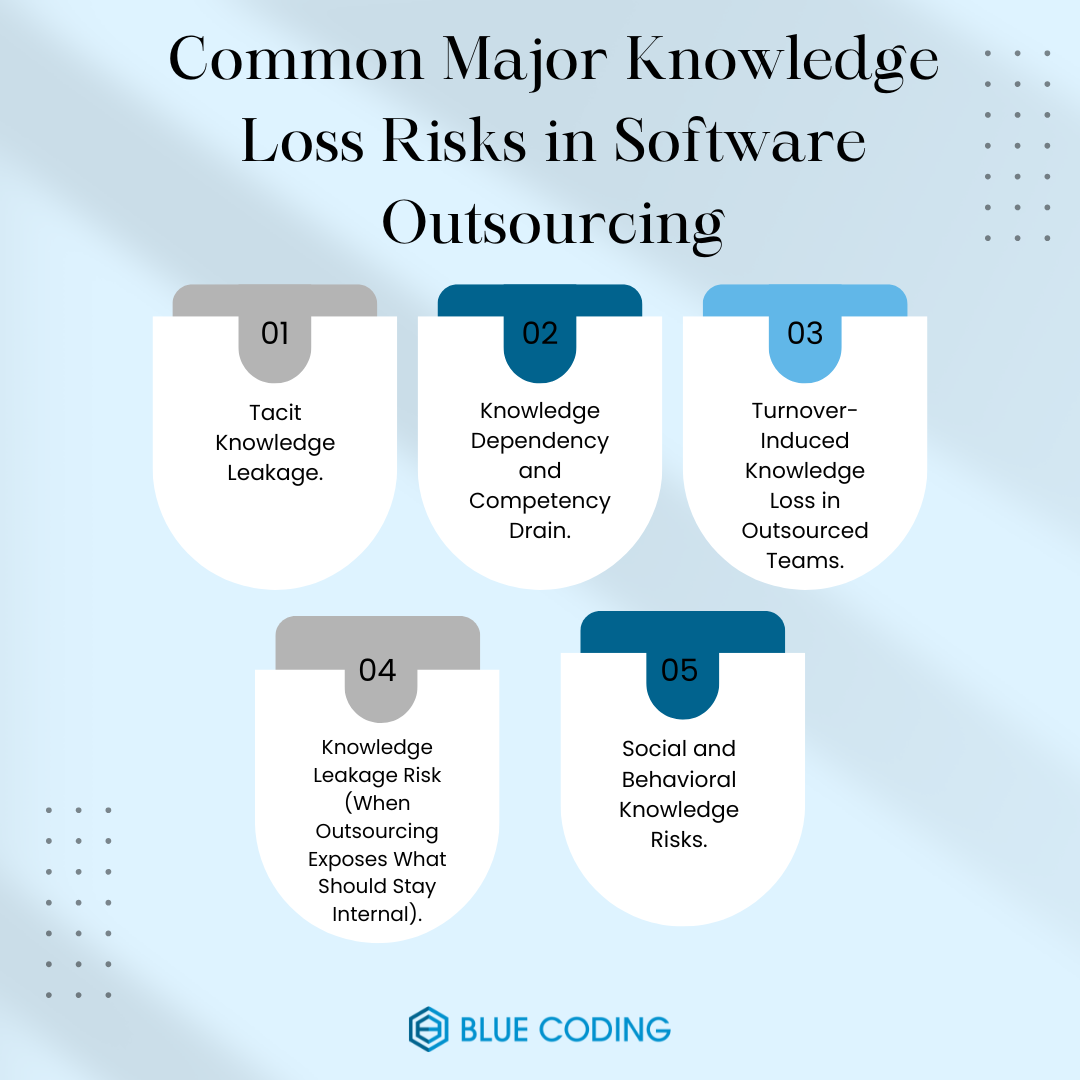
When companies outsource nearshore development, most conversations focus on cost savings. But in reality, the biggest risks often have nothing to do with money. One of the most serious and long-term risks is knowledge loss. This type of risk is harder to notice early on, but once it happens, it is very difficult to fix.
Knowledge loss affects how well a company understands its own systems, how confidently it can make technical decisions, and how easily it can grow or innovate in the future. Research in software engineering and IT outsourcing shows that when knowledge is not properly transferred, protected, and retained, companies slowly lose control over their technology. The following sections explain the main knowledge-related risks in software outsourcing, excluding cost, and why they matter in real-world projects.
Not all software knowledge is written down. A large part of it lives in people’s heads. This includes why certain decisions were made, which shortcuts were taken, what problems were faced in the past, and which parts of the system are sensitive or risky.
This kind of knowledge is called tacit knowledge. It develops over time through hands-on work, discussions, and problem-solving. Even the best documentation cannot fully replace it.
When software work is outsourced, knowledge transfer usually focuses on visible things such as code, tickets, and documents. While these are important, they do not explain the full story behind the system.
Outsourced teams may understand what the system does, but not why it was built that way. They may not know which decisions were made under pressure, which features were compromises, or which parts of the system should be handled with care. As a result, they often need extra time to figure things out on their own.
→ Teams spend time re-learning things that were already known
→ Small changes take longer because the system feels risky to touch
→ Bugs appear because old assumptions are misunderstood
→ The system slowly becomes harder to maintain
Knowledge dependency happens when a company relies so much on an external team that it slowly loses its own technical understanding. This does not happen overnight. It builds up quietly as more decisions and responsibilities move outside the organization. Internal teams stop being involved in deep technical work. Instead, they review updates, approve changes, or pass requests to the vendor. Over time, their ability to fully understand the system fades.
When internal teams no longer understand the system well, they cannot properly evaluate technical decisions. They may accept solutions without questioning long-term impact, simply because they lack the knowledge to challenge them.
This creates a power imbalance. The vendor becomes the main source of truth, while the client becomes dependent on external advice for even basic decisions.
→ Internal teams lose confidence in managing their own systems
→ Vendor lock-in becomes more likely
→ Technical decisions are harder to control
→ Innovation slows because the company depends on others to lead
People leaving projects is normal. However, in outsourced nearshore development teams, frequent turnover can cause serious knowledge loss if it is not managed properly. Each developer builds up an understanding of how the system works over time. They learn which parts are fragile, what has failed before, and what trade-offs were made. When they leave, this understanding often leaves with them.
Many nearshore development outsourcing setups prioritize flexibility. Team members may change based on availability, new contracts, or internal rotations. If knowledge transfer between outgoing and incoming team members is weak, the same learning process has to start again.
Documentation helps, but it rarely covers everything. Much of the real understanding comes from experience.
→ New team members need a longer ramp-up time
→ Old mistakes are repeated
→ Delivery slows down even when the team size stays the same
→ Accountability becomes unclear
Knowledge leakage happens when important or sensitive information moves outside the company’s control and is no longer fully protected. This can include system design, business rules, internal workflows, technical strategies, or decision logic that gives the company an advantage. When this knowledge is shared without clear boundaries, it becomes harder to ensure long-term knowledge retention within the organization, as critical insights begin to live outside internal teams rather than being embedded in shared processes and understanding. Unlike knowledge loss, this knowledge does not disappear. Instead, it exists outside the organization, where it can be reused or shared in ways the company did not intend.
Outsourcing requires sharing internal information. This is unavoidable. But once that knowledge leaves the company, it becomes harder to control who has access to it and how it is used.
The risk increases when vendors work with multiple clients in the same industry or when subcontractors are involved.
→ Loss of competitive advantage
→ Reduced uniqueness of internal systems
→ Higher risk of imitation
→ Weaker control over intellectual property
Knowledge sharing does not happen automatically. People choose how much they share based on trust, ownership, and motivation. In outsourced relationships, teams may focus only on what is required by the contract. Anything extra, such as sharing lessons learned or future risks, may not happen naturally.
Outsourced teams may not feel long-term responsibility for the system. Cultural differences, time zone gaps, and limited direct interaction can also reduce open communication.
Even with good tools and processes, these human factors strongly influence how well knowledge flows.
→ Misunderstandings between teams
→ Assumptions replacing shared understanding
→ Missed opportunities for improvement
→ Problems discovered too late
Keeping track of knowledge-related risks in software outsourcing is critical for long-term stability, growth, and decision-making. When companies do not actively monitor these risks, problems often appear much later, when they are harder and more expensive to fix. By then, key people may have left, systems may have grown more complex, and internal understanding may already be weak.
Tracking these risks helps companies stay in control of their own technology. It allows teams to spot early signs of knowledge gaps, rising dependency on vendors, or repeated mistakes caused by lost context. This visibility makes it easier to act early, whether that means improving documentation, involving internal teams more closely, or adjusting how work is shared. Most importantly, consistent tracking supports strong knowledge retention. It ensures that critical insights, decisions, and lessons learned are not tied to a single person or external team. Instead, they become part of the organization’s shared understanding, helping the business move faster, adapt more easily, and make smarter long-term choices.
We understand that managing software outsourcing risks is vital to protect knowledge, maintain control, and keep your teams aligned. Our approach combines clear processes, continuous monitoring, and proactive knowledge retention so that your projects stay on track without losing critical insights. With years of experience in nearshore software development, we help companies navigate complex outsourcing arrangements while safeguarding both technical and business knowledge. If you want to make sure your outsourcing projects are efficient, secure, and fully under your control, get in touch with us today. Contact us to see how we can support your next project! We do offer a free initial consultation call as well!


Subscribe to our blog and get the latest articles, insights, and industry updates delivered straight to your inbox



