Use our guide to find and hire the best C++ developers from Latin America. Get to know the best strategies and principles to use when hiring C++ developers.


.svg)
.svg)
The world of software development continues to evolve, with a huge number of programming languages and frameworks providing support to diverse application requirements. Among these, C++ remains a primary language, renowned for its performance, fantastic tools, versatility, and heavy usage across various domains including system programming, game development, embedded systems, and high-performance computing. Today's post will act as a guide to hiring C++ developers in 2024. We will do this by offering insights and strategies to help organizations identify and recruit top talent proficient in C++ programming languages.
Software development C++ is a powerful, statically typed programming language known for its efficiency, performance, and flexibility. Initially designed as an extension of the C programming language, C++ introduces object-oriented programming (OOP) features, templates, and standard libraries, making it suitable for building complex and scalable software systems. C++ software development language finds application in a wide range of domains, including operating systems, device drivers, game engines, financial systems, and scientific simulations. C++ developers utilize this language to develop robust, high-performance applications that demand low-level control, efficient memory management, and optimal resource utilization. From designing algorithms and data structures to implementing platform-specific optimizations, C++ developers possess the expertise to develop efficient and scalable solutions tailored to fit any kind of requirements.
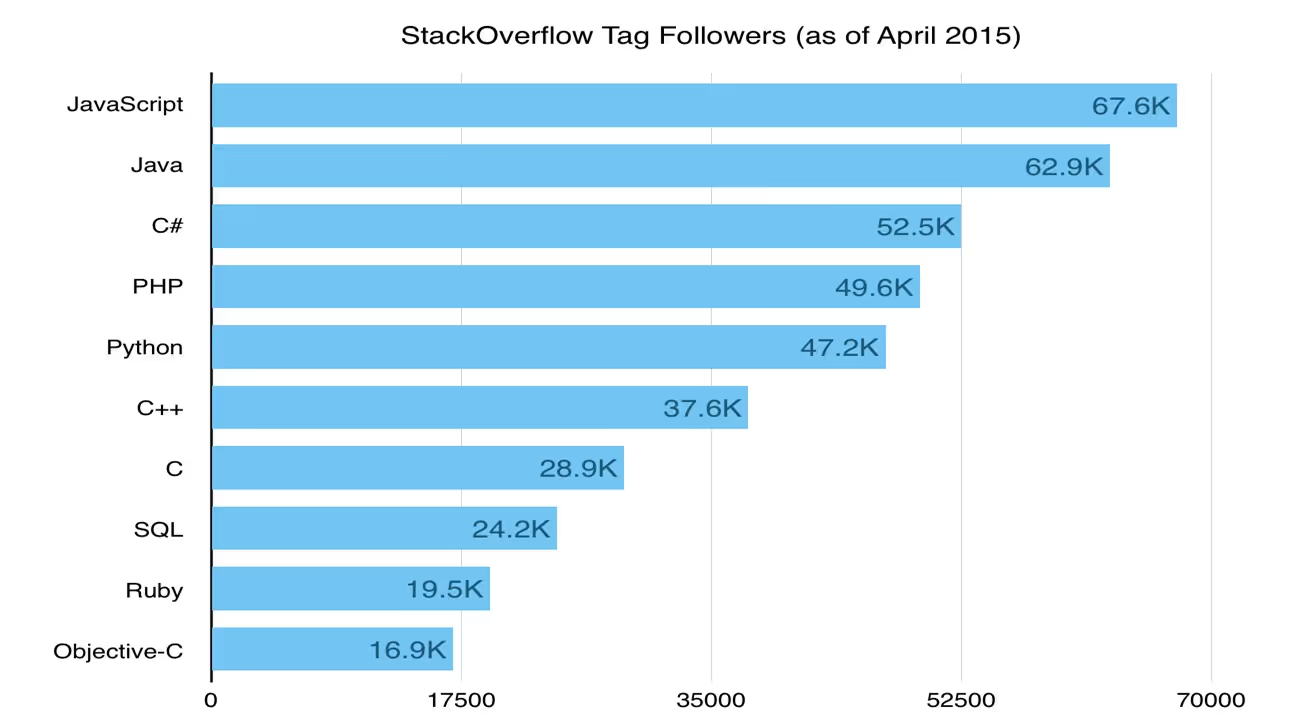
C++ developers must demonstrate a deep understanding of the language syntax, semantics, and best practices. They should be proficient in memory management, pointer arithmetic, and resource allocation strategies to write efficient and reliable code.
C++ programming language is renowned for its support for object-oriented programming paradigms. C++ developers should be adept at designing and implementing class hierarchies, inheritance relationships, polymorphic behavior, and encapsulation principles to build modular and extensible software architectures.
The Standard Template Library (STL) is a core component of C++, providing a collection of generic algorithms, containers, and iterators. C++ developers should be familiar with STL components such as vectors, lists, maps, algorithms, and iterators to leverage the power of reusable and efficient data structures and algorithms.
C++ developers should have a thorough understanding of memory management concepts, including stack allocation, heap allocation, memory leaks, and smart pointers. They should be proficient in managing memory resources efficiently to prevent memory-related issues and optimize application performance.
C++ developers should be familiar with compiler optimizations, build systems, and debugging tools specific to the C++ ecosystem. They should understand the intricacies of compiling C++ code, linking external libraries, and generating optimized machine code for different target platforms.
C++ provides robust support for multi-threading and concurrency through features like threads, mutexes, condition variables, and atomic operations. C++ developers should be proficient in designing and implementing concurrent algorithms, synchronization primitives, and thread-safe data structures to ensure scalable and responsive applications.
C++ developers should be skilled in using debugging and profiling tools to diagnose and optimize software performance. They should be familiar with tools like GDB, Valgrind, and profilers to identify memory leaks, performance bottlenecks, and code inefficiencies, facilitating the development of reliable and efficient C++ applications.
C++ developers should be well-versed in software design patterns, architectural principles, and coding standards. They should adhere to best practices such as modularization, abstraction, separation of concerns, and code reusability to build maintainable, scalable, and extensible software systems.
C++ developers should have experience working with popular C++ frameworks and libraries relevant to their domain. Whether it's game development with Unreal Engine, GUI development with Qt, or network programming with Boost.Asio, familiarity with industry-standard frameworks and libraries enhances productivity and accelerates development cycles.
The field of software development is dynamic, with new technologies, tools, and paradigms emerging regularly. C++ developers should demonstrate a commitment to continuous learning, staying updated with the latest developments in the C++ ecosystem, exploring new libraries and frameworks, and adopting best practices to improve their skills and stay competitive in the industry.
As mentioned above, C++ is a popular programming language and this means that the demand for C++ developers is extremely high. It can be extremely challenging for businesses to find the right developers without wasting too many of their resources in candidate hunting. Therefore, we recommend businesses to opt for nearshore outsourcing via a dedicated outsourcing agency. At Blue Coding, we aim to connect our clients with the best talent from the Latin American region. Our services include custom software development, tech staff augmentation, and IT consultancy. To learn more about us, schedule a free strategy call by contacting us now!


Subscribe to our blog and get the latest articles, insights, and industry updates delivered straight to your inbox