Forget the hype of the early 20s. We dive deep into the real software market trends of 2026, where Physical AI and Edge computing finally take center stage.

.svg)
.svg)
Welcome to the year 2026!! It is incredible to look back and see how much the concept of technology has shifted in such a short amount of time. If you are a developer, a business leader, or just someone who follows the pulse of innovation, you have likely noticed that the frantic energy of the early 2020s has matured into something far more stable and practical. We are no longer living in a world of mere "potential" when it comes to technology. Instead, we are living in a world of high-impact results.
Staying informed about the latest software market trends has become a necessity for anyone looking to stay competitive. Businesses are now asking how these tools can drive actual efficiency, lower carbon footprints, and create more secure environments for users. In this deep dive, I want to share the most significant shifts we are seeing this year. Whether you are managing a global enterprise or working as a solo developer, these insights will help you navigate the complex world of the software industry trends 2026 has brought to the forefront.
Just a few years ago, the world was obsessed with simple chatbots. You would ask a question, and a large language model would provide a text-based response. While impressive at the time, that technology feels basic today. One of the most dominant software industry trends 2026 is currently experiencing is the transition from "Assistant AI" to "Agentic AI."
Agentic AI refers to systems that do not just talk but actually act. These agents can plan complex projects, coordinate with other software agents, and execute multi step workflows with very little human intervention. For instance, a procurement agent might notice that inventory is low, research the best prices from five different vendors, negotiate a bulk discount based on historical data, and finalize the purchase order before the office even opens for the day.
This shift means that software is evolving into a proactive partner. For the broader market, this represents a massive leap in productivity. For those watching the software development market trends, it means that the architecture of our applications is changing. Developers are now focused on building "orchestration layers" that allow these autonomous agents to work together safely and effectively without breaking the system.
When we look at the current software development market trends, it is impossible to ignore how the actual process of building software has been reinvented. In 2026, the era of manual coding is largely over for routine tasks. Over 90% of development teams now use AI as a primary collaborator throughout the entire software development life cycle.
We have moved far beyond simple code completion. Modern AI engines are now capable of AI-assisted Code Engineering. They can take a rough architectural diagram and generate a fully functional, containerized microservice in minutes. They can also refactor legacy codebases that have been sitting untouched for a decade, modernizing them for the cloud without introducing new bugs.
This has changed what it means to be a junior developer. Today, entry-level roles are less about writing syntax and more about logical oversight. A developer in 2026 acts more like an editor or an architect. They guide the AI, provide it with the necessary business context, and ensure that the output meets the high standards required for production. This evolution is one of the most exciting software market trends because it allows human creativity to stay at the center while the machine handles the repetitive labor.
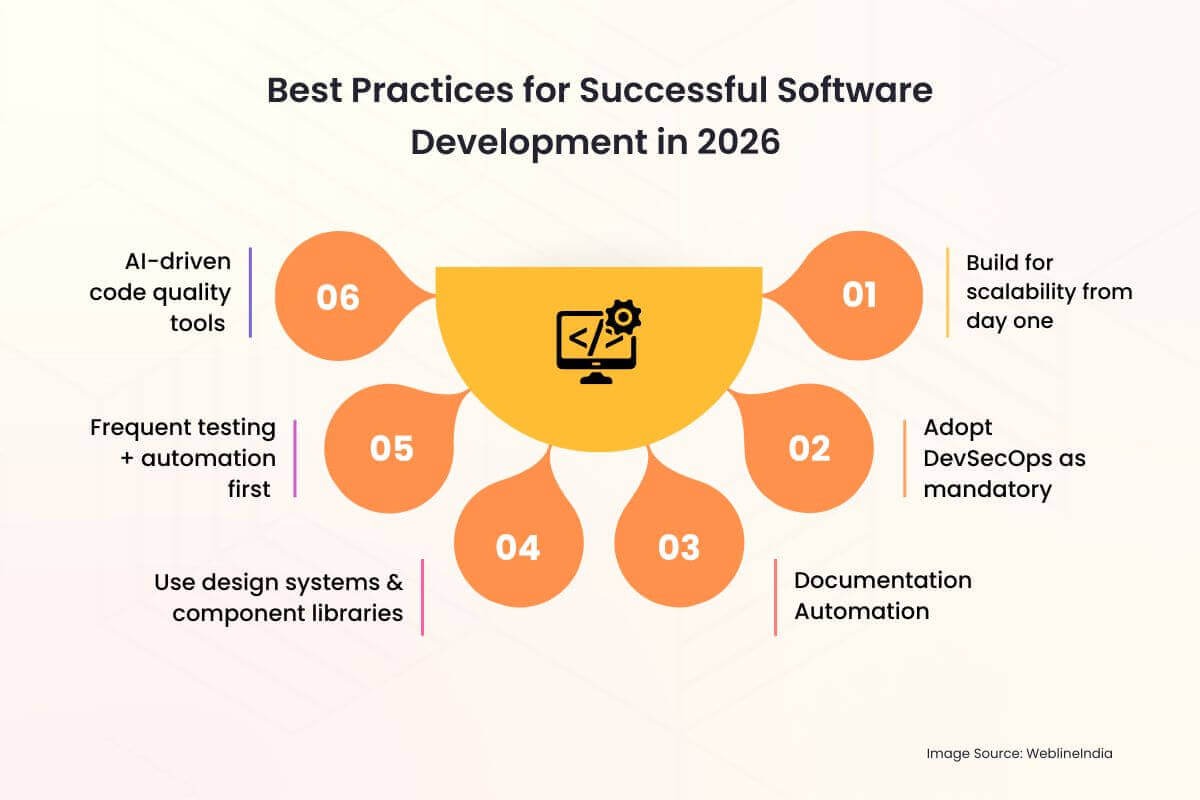
As software systems have become more complex and interconnected, the cognitive load on individual developers started to become a major bottleneck. This led to the explosion of platform engineering, which is now a cornerstone of the industry. By 2026, almost every large organization has moved away from traditional DevOps in favor of internal developer platforms.
Platform engineering is all about creating a "golden path" for developers. Instead of every team having to figure out how to set up their own cloud infrastructure, security protocols, and deployment pipelines, they use a centralized platform that handles it for them. This self-service model means a developer can go from an idea to a live staging environment in a single click.
This trend is helping companies reduce the "time to value" for new features. It also ensures that security and compliance are baked into the software by default, rather than being added as an afterthought. For businesses, the benefit is clear: more innovation and less "plumbing" work.
GreenOps and Sustainable Software.
One of the most sobering software industry trends 2026 has seen is the increased focus on the environmental impact of computing. With the massive growth of AI models and data centers, the energy consumption of the tech industry has come under intense scrutiny. This has given birth to the GreenOps movement.
GreenOps is the practice of optimizing software for energy efficiency. In 2026, developers are being judged not just on how fast their code runs, but on how much electricity it consumes. This has led to several interesting changes in the market:
The nature of digital threats has changed dramatically. Hackers are now using the same AI tools that developers use, allowing them to launch sophisticated, automated attacks at a scale we have never seen before. In response, the software market trends of 2026 have shifted toward a Digital Immune System approach.
Traditional security was like a wall around a castle. Once someone got inside, they had free rein. Modern security is more like a biological immune system. It assumes that threats will get inside, so it continuously monitors the "health" of the system. If it sees a piece of code acting strangely or a user accessing data they don't need, it can automatically isolate the threat and heal the system before any damage is done.
We are also seeing the rise of "Confidential Computing," where data is encrypted not just while it is sitting on a hard drive, but even while it is being processed in the CPU. This is becoming a baseline requirement for industries like healthcare and finance where privacy is paramount.
Edge Computing and Physical AI.
For years, the trend was to move everything to the "Cloud." But in 2026, the pendulum has swung back toward the "Edge." Edge computing involves processing data as close to the source as possible, whether that is a smart camera, a factory sensor, or a wearable medical device.
The main driver here is "latency." For an autonomous delivery drone or a self-driving car, waiting a few hundred milliseconds for a cloud server to respond is too long. By moving the "brains" of the software to the edge, these devices can make split second decisions in real time.
When you combine this with the latest software development market trends, you get what we call "Physical AI." This is software that interacts directly with the physical world. We are seeing software-driven robots in warehouses that can "see" and "think" just like a human, and smart cities that can adjust traffic patterns and energy usage on the fly based on real-time data from millions of sensors.
Finally, we have to acknowledge the rise of the "citizen developer." In 2026, you don't need a computer science degree to build a functional application. Low-code and no-code platforms have become so sophisticated that people in HR, marketing, and sales are building their own automation tools.
These platforms often use natural language interfaces. A manager can simply describe the tool they need, and the platform generates the underlying logic, connects to the necessary databases, and builds the user interface. This doesn't replace professional developers. Instead, it frees them up to focus on the truly difficult engineering problems while the rest of the organization handles their own day to day productivity tools.
The Blue Coding team has spent years watching these shifts happen in real-time, and we know that staying ahead of the software market trends is about more than just hiring people who can write code. It is about finding the right talent that understands the intersection of AI, efficiency, and business value. We specialize in connecting companies with the top 1% of software engineering talent from Latin America, ensuring that your team has the specialized skills needed to navigate the software industry trends 2026 has introduced. Whether you are looking to implement Agentic AI or transition your infrastructure toward platform engineering, we provide the expertise to make it happen without the overhead of traditional hiring. If you are ready to scale your engineering team with experts who truly understand the 2026 software market, we would love to help you get started. Contact us today to learn how Blue Coding can help you build the future of your business. We can start with an initial complimentary strategy call!


Subscribe to our blog and get the latest articles, insights, and industry updates delivered straight to your inbox