Is nearshore outsourcing still worth it in 2026? Explore the latest software outsourcing trends and see why nearshore beats offshore for real-world ROI.

.svg)
.svg)
It’s hard to believe we’ve already made it to 2026. If you look back at the tech predictions from just a few years ago, the experts were convinced that by now, AI would be writing 100% of our code while we all sat on beaches. While AI has certainly changed the game, the reality on the ground is a bit more grounded. We aren’t out of jobs; we’re just working on much bigger, more complicated puzzles. The death of outsourcing was a popular headline back in 2024. People thought that if an LLM could spit out a Python script in ten seconds, why would anyone bother hiring a team in another country? But as we’ve seen over the last year, the demand for high-quality, human-led engineering has actually spiked. Instead of us needing fewer people, we actually need better people who can steer the AI tools effectively.
This brings us to the million-dollar question that every CTO, founder, and product manager is grappling with this year: Is nearshore outsourcing still worth the extra cost, or has the global tech landscape leveled the playing field? To answer that, we have to look past the sales pitches and dive into the actual economics and logistics of building software in 2026.
To understand the worth of any strategy, we first have to look at the environment. In 2026, software outsourcing trends have shifted from simple cost-cutting to what I like to call strategic integration. A few years ago, outsourcing was often a black box. You sent requirements over a wall, waited three months, and hoped the result didn't crash your servers. Today, that model is effectively extinct. If you aren't working in a continuous, real-time feedback loop, you’re already behind your competitors. One of the biggest software outsourcing trends we’ve seen lately is the move toward autonomous product pods. Instead of just hiring three developers to supplement your local team, companies are now hiring entire functional units,production-ready such as owners, designers, and engineers, who operate as a self-contained engine.
This requires a level of communication and trust that simply wasn't possible with the old task-ticket method. Furthermore, the AI-augmentation era has changed the value of a junior developer. In 2026, the average junior dev is as productive as a mid-level dev was in 2022, thanks to sophisticated co-pilots. This means that when you outsource, you’re no longer looking for hands to type; you’re looking for brains to think. You need partners who can navigate complex architectures and ensure that the AI-generated code doesn't create a massive pile of technical debt.
The current landscape also places a massive premium on security and data residency. With the latest global regulations on AI training data, where your developers sit matters. It’s no longer just about the code; it’s about the legal framework that code is written in.
When we talk about the choice of nearshore vs offshore 2026, we have to be honest about what we’re actually paying for. Offshore (traditionally meaning regions like Southeast Asia or parts of Africa for Western companies) still offers the lowest hourly rates on paper. You can find brilliant talent in these regions for $30 or $40 an hour.
However, the latency of collaboration has become a much heavier tax than it used to be. In 2026, the world moves at the speed of a digital message. If your team is in a time zone that is 10 to 12 hours ahead or behind you, you are essentially operating on a 24-hour delay. When comparing nearshore vs offshore 2026, the nearshore model (working with talent in similar time zones, like Latin America for the US or Eastern Europe for the UK) offers something that offshore struggles to match: synchronous creativity.
Imagine you’re in the middle of a high-stakes product launch. A critical bug appears at 2 PM.
In the fast-paced market of 2026, that 34-hour difference is a delay and it's a lost opportunity. It’s the difference between a successful launch and a social media PR nightmare. Nearshore teams act as a natural extension of your office, allowing for the kind of spontaneous brainstorming that is impossible when one half of the team is always asleep.
We need to stop looking at hourly rates as the primary metric for success. It’s a trap. If you hire a developer for $40 per hour but it takes them twice as long to understand your requirements because of cultural or linguistic barriers, your cheap developer actually costs $80 per hour.
To find your true outsourcing ROI, you have to look at the total cost of ownership. This includes:
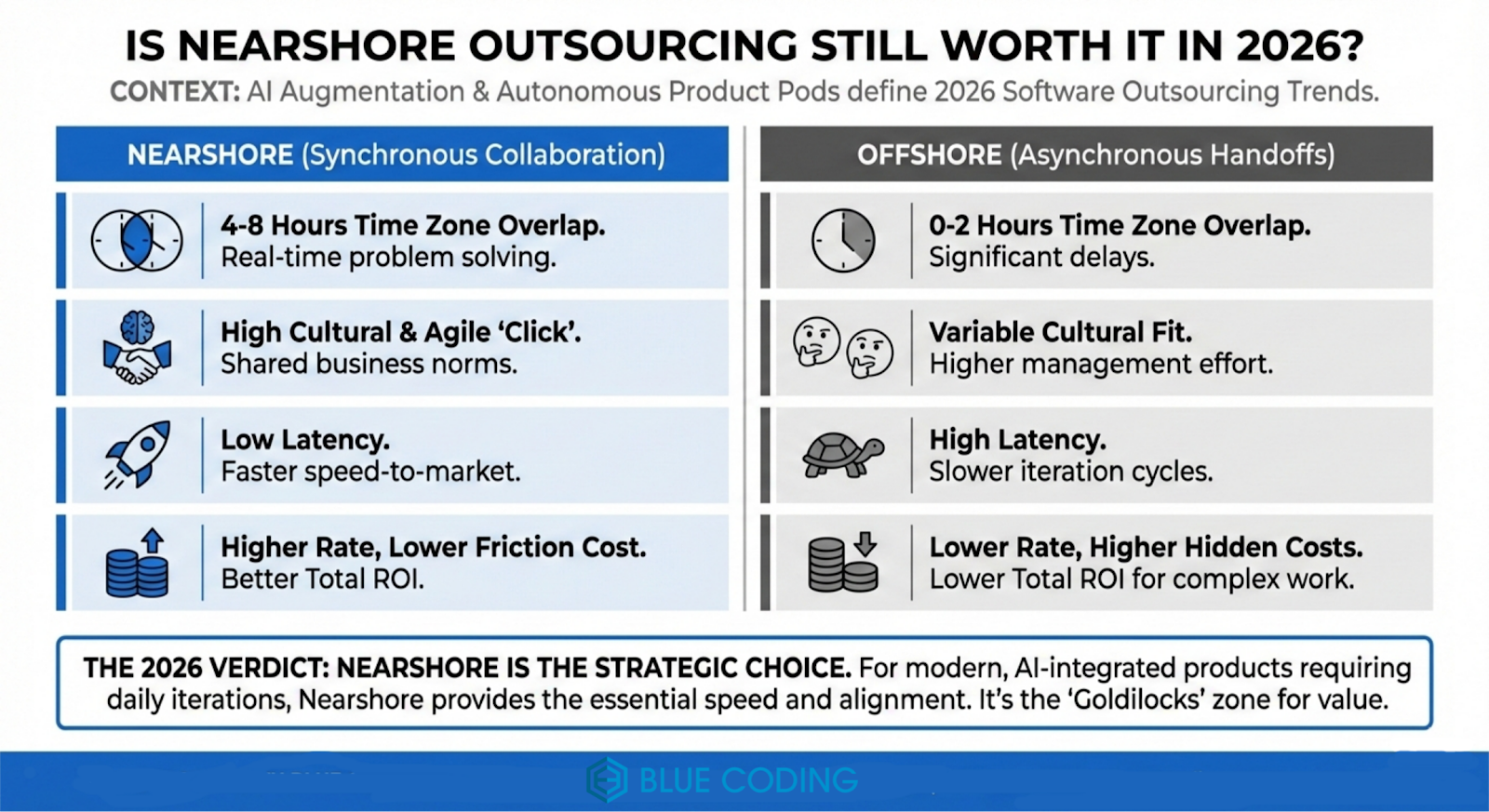
Nearshore outsourcing has matured significantly over the last few years. In the early 2020s, many nearshore hubs were still emerging. By 2026, regions like Costa Rica, Colombia, Poland, and Romania have become world-class tech powerhouses. They aren't just cheap alternatives anymore; they are centers of excellence. There are several specific reasons why nearshore outsourcing is winning the debate this year:
Agile methodology relies on ceremonies: daily stand-ups, sprint planning, and retrospectives. These are meant to be collaborative. If half the team is yawning because it’s 3 AM for them, the Agile part of your process is broken. Nearshore teams participate in these ceremonies with the same energy as your local team.
We often underestimate how much business etiquette and shared cultural references matter in product development. When a nearshore developer understands the nuance of your user's frustration, they build better features. In 2026, where the user experience is the only thing that separates you from an AI-generated clone of your app, these soft skills are priceless.
Many nearshore countries have spent the last decade over-investing in STEM education. In 2026, these regions have a massive surplus of senior-level talent that is fluent in the latest AI frameworks. This isn't just about saving money anymore; it's about accessing talent that you simply cannot find in New York, London, or San Francisco due to local talent shortages.
In 2026, corporate social responsibility is at the forefront of business. Working with nearshore partners often means working with teams that have similar labor standards and environmental regulations. This makes it much easier to maintain an ethical supply chain for your digital products.
So, is it still worth it?
If you are looking for a partner to help you navigate the complexities of 2026, someone who can use AI to accelerate your roadmap, someone who can jump on a call at 10 AM to solve a crisis, and someone who understands your business goals as well as you do, then yes. Nearshore outsourcing is more than worth it; it’s a competitive necessity. The era of throwing code over the wall is over. We are in the era of integrated, global talent. While offshore remains a viable option for maintenance of legacy systems or non-critical, high-volume tasks, the core of your innovation should be nearshore.
When you look at your budget for the next fiscal year, don't just look at the bottom line of the invoice. Look at the velocity of your team, the quality of your code, and the sanity of your project managers. When you weigh all those factors, the nearshore model provides a level of value that the cheapest option simply cannot touch. The goal is to build a business. And in 2026, the best way to do that is with a team that is actually on your team, no matter which side of the border they are on.
Blue Coding has spent over a decade proving that nearshore outsourcing is the smartest way to build great tech. We specialize in assembling the high-performing product pods you need to stay competitive in 2026. Whether you're scaling a startup or modernizing an enterprise, we bring the right talent and strategy to your team. Contact us today to book your complimentary strategy call and let’s get your project moving.


Subscribe to our blog and get the latest articles, insights, and industry updates delivered straight to your inbox